



Were you a customer of Minnesota Rusco?
When Your Contractor Disappears Overnight: what To Do Before You Do Anything
Are you looking for answers? If so, give us a call or fill out our contact form for assistance.
Were you a customer of Minnesota Rusco?
When Your Contractor Disappears Overnight: what To Do Before You Do Anything
Are you looking for answers? If so, give us a call or fill out our contact form for assistance.
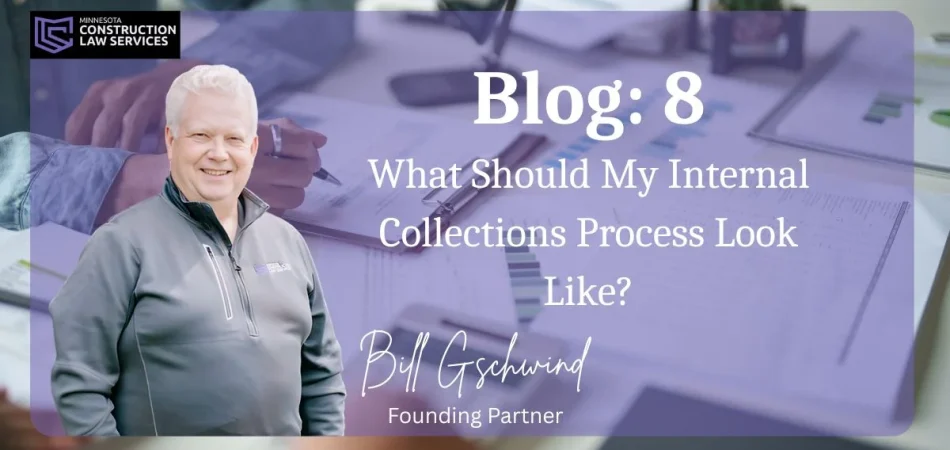
Editor’s Note: This is the eighth and final installment in an eight-part series of posts by Bill Gschwind, business and construction attorney and founder of Minnesota Construction Law Services. Bill brings years of experience helping contractors get paid without wasting time, leverage, or sanity.
If you’ve made it this far in the series, you’ve heard a lot about mechanics’ liens, contracts, unpaid invoices, and collection strategies. So, let’s bring it home: what does an actual internal collections process look like for a contractor?
The answer isn’t complex – but it has to be consistent.
At Minnesota Construction Law Services, we work with owner-operators to put a system in place that helps you act before the problems become uncollectable. Here’s how we recommend building your own internal collections process.
It starts before the first invoice goes out. Your contract should spell out:
If we drafted your agreement, it includes a collections cost recovery clause. That’s leverage. And it’s the beginning of a process you’ll be able to enforce later.
Invoice as soon as possible. Delay is the enemy of collections.
Once that invoice goes out, track the due date. Use your accounting software or a spreadsheet – but track it.
At 30 days past due, send a reminder. At 45 days, follow up again. At 60, escalate the tone and prepare for action. At 75 days, hand it off. That’s the maximum threshold we recommend.
Why 75? Because collection success rates plummet after that point, and Minnesota’s lien deadlines are ticking in the background. Don’t let the timeline expire while you’re still being “nice.”
Not every invoice is worth fighting for – but every invoice should be evaluated early.
Too often, contractors hold onto bad debt out of emotion or denial. But that overdue $12,000 isn’t just a number. If your profit margin is 15%, you’ll need to book $80,000–$100,000 in new work to make that loss back.
Don’t let uncollected A/R sit on your books and distort your decision-making. If it’s bad, clear it off. If it’s collectible, escalate it.
Talk to your accountant. And if you’re unsure, talk to us.
You’re not a collections agency – you’re a contractor. So don’t try to chase every late payment personally.
Automated invoice reminders, scheduled follow-ups, and templated emails can help you stay consistent without spending hours every week chasing down stragglers.
You’re not being rude. You’re being professional.
This might be the most important part of your process: knowing when to let go.
Once you’ve sent two or three reminders with no response, the odds of recovery start to drop fast. Customers who intend to pay will usually respond by then. The rest are waiting to see how serious you are.
By Day 75, it’s time to move it out of internal A/R and over to legal collections. That doesn’t mean you’re going nuclear – it means you’re enforcing your rights.
When MNCLS takes over, we assess lien rights, review the contract, and send a demand that shows the customer you’re serious – and that you’ve got legal support behind you.
Every collection is a chance to improve your system. Did you:
Track where things broke down and fix them. Over time, your need for collections will drop, and your margins will rise.
Collections isn’t about being aggressive. It’s about being prepared.
With the right internal process, you’ll know who owes you money, when it’s due, and what to do when it’s late. You’ll protect your lien rights. You’ll protect your cash flow. And you’ll spend more time running your business—and less time chasing checks.
Let’s put that system in place.
Missed a post? Here’s the full series:
Questions about collections? Let’s talk. This is what we do.

Fields Marked With an “*” are Required
"*" indicates required fields

The mission of Minnesota Construction Law Services is simple, we want to help you build and protect your business. We give you practical solutions, ones that will grow your business, not pad our wallet.
3030 Centre Pointe Dr.
Ste 100
Roseville, MN 55113
Copyright 2026 Minnesota Construction Law Services. All rights reserved.
*Images are obtained under license from Canva and other third-party stock image providers, with attribution included where required.
Digital Marketing By:
